Sunday, June 26, 2011

35th Commencement June 17, 2011 Boricua College Class of 2011: J. Wesley Beeks Guest Speaker

Photography by J. Wesley Beeks.


Elated Graduate walks 


Student Council Representative Jeffrey Diaz and fellow graduate


Student Council Representative Eric Morales receives the Roberto Clemente Academic Excellence Award


Faculty Facilitators


Graduates of Boricua College


    Student Council Representative Manhattan Learning Center

                                       Education Committee Coordinator : J. Wesley Beeks

                                             Thirty Fifth Commencement June 17, 2011


Good evening, Dr. Alicia, members of the Board of Trustees, faculty facilitators and especially the graduating class of 2011.


Democracy is not a hope but a reality. The graduating class of 2011 has fulfilled that reality with their active perseverance in completing their degree programs and their commitment to a global awareness through education.


We persevere through an honest introspection of ourselves. The person who is educated is one who embraces and fully accepts the principles of an education. Such a person becomes the master of these principles and through their application is able to create realistic models that children, parents, family and friends can build upon.


Education is meant to transform and inspire one towards awareness and achievement. We all carry the knowledge of our collective ancestors who sacrificed their culture, traditions, and their lives for our benefit. This knowledge sometimes created restrictions in what we could achieve.


There is a paradigm that suggest that sometimes one should think outside of the box to be creative. I believe the time has come to throw away the box and work and create without any restrictions.

You the graduates here tonight have demonstrated that everything can be achieved wit faith, work, and perseverance.

Boricua College has embraced you and facilitated your learning and tonight you are graduates of the world.

You are the hope of the world with the ability to create and become the anchors on which we can build the future.

                                              Congratulations class of 2011


Human Services Master Graduate

President  of Boricua College- Dr. Alicia and student

Saturday, June 4, 2011

July is National Minority Mental Health Month

                                                                        by J. Wesley Beeks


      Mental Illness is not a stigma but indicator of where healing is needed in our communities.Latinos and  African- American must begin to actively recognize how mental health can be negatively impacted by psychosocial triggers. discrimination, anger and helplessness are added is  a cocktail for disaster.

      Take the first step towards healing by recognizing how your emotions can play a part in your mental health. When faced with a conflict whether personal or professional consider which path best works for you. Aggression and Passivity can motivate others towards actions. Assertion allows one to be aware and capable of seeing all sides for negotiation.

      Support your community centers that provide mental health services by volunteering. Support our families by removing the stigma associated with mental illness with full support.

Conflict Resolution and Recovery- Dr. Kazuko


Dr. Kazuko receives a Humanitarian  Award from  Meaningful World Founder Dr. Ani Kalayjian and         VP  Jennifer De Mucci for her outreach effort in response to the Earthquake  March 11, 2011   photo by Oleg


    Dr. Kazuko Tatsumura Hillyer shared her insights and collective work efforts in the recent earthquake in Japan. She is currently heading the Manjushree Project which is instrumental in the cultural integrity and survival of orphans who have been traumatized by war and massacre. Manjushree is an orphanage located just across the border from China (Tibet), Bhutan, and Myanmar at the northeastern tip of India. A rare old Himalayan Tibetan culture is preserved here to the fact it was saved from Chinese invasion. This holds historic value as it is the birth place of HH the 6th Dalai Lama, an unique Tibetan Monastery, the second largest in the world. Here there are 182 children living and receiving a modern education and learning the traditional ways of Tibetan life. Dr. Kazuko Tatsumura Hillyer has gone there in November 2010 flying to Tawang and saw the construction of temporary school building and have leant their expertise and academic support. She was also fortunate to have met the Dalai Lama’s ORACLE who gives spiritual advice to him and received a deep blessing. They have raised $50,000 with the total project cost at $360,000.


Her other endeavors are the GAIA Holistic Center which is a consortium of holistic practioners who came together in the wake of the World Trade Center tragedy on September 11, 2001. Some of the holistic therapies provided are:

Okido/Shinkiko Classes and Seminars

Onnetsu Far Infra Red therapy and training

Tibetan Medicine therapy and training

Japanese Hari Acupuncture


In particular interest was Dr. Kazuko’s FIR Onnetsuki and Onnetsu Mat. Onnetsu therapy is an infra red therapy bases on NASA’s findings and the ancient Japanese modality of MOXA. She has used this therapy in case treatments of Parkinson’s disease, pollen allergy, prostate cancer, spine injury, thyroid cancer, HIV, herniated disc, breast cancer, Bipolar disorder, atopic dermatitis, stomach cancer, Tuberculosis, and many other ailments.

Dr. Kazuko is an engaging woman with a strong spirit that reaches beyond her lithe frame. She spoke of the earthquake in March 11, 2011 that devatsted Japan. One could see the angst swelling inside her as if she was to implode. The reflection of her tears demonstrated the strength and vitality of the Japanese. Speaking of the collective organization of Japan she contrasted her own passion for individualism celebrated in the United States as the expected norm. This cultural contrast was apparent as she held two values within herself. Immediately she made plans to get on a plan and help but was distracted by the concerns of her colleagues and friends. Their reaction was to coordinate the outrach and recovery alas Dr. Kazuko was moved to go immediately and followed her passions. Her passion is insticinctive and she is not moved by peripheral design. The impact of the earthquake was devastating as it interrupted the cultural and tradions of the Japanese. She responded that in Japanese custom one takes a hot bath each day and with the lack of hot water and unhealthy conditions this was a breech in customs. There was a reticence for Japanese in their willingness to receive from her as they do not share their problems with outsiders. Ethnically Dr. Kazuko was Japanese but culturally she was seen as Japanese American and not a native. An elderly woman with her hair pulled back was carrying water with an arched back in pain, finally she learned to trust Dr. Kazuko after several weeks. In her language she said the to answer the questions or take assistance from others was seen as improper. For Japanese to do so would be seen as complaining about their hardships despite the apocalyptic conditions. A graduate from the trainings shared this value and stated that as she is Japanese she was viewed as an outsider and had great difficulty in assisting in the recovery offerts over there.

Her philosophy in the recovery efforts was that she felt God would not have let her the Japanese people suffer with the nuclear plants and mass deaths if they could not serve as an example of survival if they could not bear it. The concepts of Buddhims were discussed with an emphasis on compassion.

Dr. Kazuko’s interpretaion on volunteerism was prolific:

“ You find what has to be done and do it! That is a volunteer. If you have to be told what to do then you are not a volunteer” .

She found a great depth in the acts of children in Japan. Children and the elderly are given provisions first as the reverance is for the youth and the elders. A child had a small container of milk which was a rarity. The child shared his milk with others in the face of all who were suffering. She commented on the resilience of the Japanese and their will to live and move forward. Dr. Kazuko did comment that now is the time for fiscal support for the Japanese as they have no export and need the financial capitols to be open to Japan for its recovery. The onslaught of the tides of bodies still buried was heavy and she shared that they honored many of the dead, known and unknown with reverance and ritual.

The impact of Dr. Kazuko’s words were not lost to me. Her intense passion and knowledge displayed professional and personal committement. Her clinical practices were instrumental in easing the trauma of surviving victims and how to identify depression and suicidal ideation that resonated in the wake of this tragedy. She is going back to Japan to follow up with members of the Gaia Holostic Health Center.


For more information Please contact::

Gaia Holistic Health Center, telephone-212-799-9711, www.gaiaholostic.com

Tuesday, April 26, 2011

Summer School is Approaching

Summer School Registration is  May 9th and Classes begin the 10th.

Make sure to stop by the financial aid office and check on your eligibility.

Friday, March 4, 2011

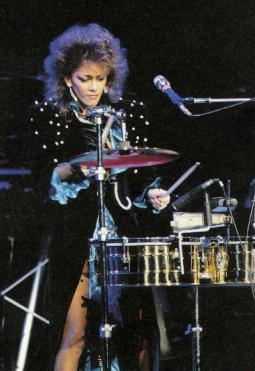
March is Women's History Month- Profile on Sheila E.

Sheila E. was born Sheila Escovedo and the daughter of Latin Jazz percussionist Pete Escovdo. Her uncle Coke Escovedo started the  famous Latin band Aztec and was a member of Santana. A child prodigy she played the violin at  five years and received a music scholarship. Her heart lay with playing percussion as her father, Pete, did and she learned to play the drums and percussion by watching and listening to her father.She proved to be a force to be reckoned with on the drums and toured with her father. Early in her career she performed with Billy Cobham, noted and talented percussionist, who Sheila toured with.

As a percussionist she had performed with Diana Ross, Marvin Gay, Herbie Hancock, Stevie Nicks, and George Duke to name a few. Her reputation was fast growing as a lethal drummer and versatile percussionist with steady studio work. As a female she encountered many challenges and stereotypes playing an instrument associated mainly with men. Her strong will and creativity allowed her to move past mundane perceptions and fast forward to the highest professional standards. Proud of her Mexican , Creole and African heritage she blends all cultures within her music.

The American and global population was introduced to the public when Prince, who followed her career, encouraged her to pursue a solo career. Until her meteoric rise there had not been a  female drummer who played, sang, composed music and fronted her own band. Karen Carpenter, of the Carpenters, was a drummer but moved to singing. Sheila Escovedo shortened her last name to the initial E. and Sheila E. was born bringing her Latin tinged infusion to funk and rock music.

She is most well known for "The Glamorous Life" which charted at #7 on the Pop Charts and #1 on the Dance Charts, " A Love Bizarre" a duet with Prince , charting at #11 on the Pop Charts and #1 on the Dance Charts.  She released  "Hold Me " a ballad which charted #3 shocking many with her ability to sing and deliver a ballad.

She has since moved into music production as the musical director of the Latin Grammy Awards  and was nominated for Grammy for music production in 2010 for the Inaugural Hispanic Music Program. Proving that looks alone do not secure longevity she parlayed her talent into a career. Her philanthropic endeavors have generated Arts programs for children with her organization Elevated Hope Foundation.


A woman on the move and who continues to grow Sheila E. is one of the women who can play with the boys and still lead the pack!

Wednesday, March 2, 2011

Student Council Mixer Survey Results by J.Wesley Beeks -Education Committee Coordinator


      On February the 10th the student council presented a mixer for the community. The following student council officers were present: President, Vice President, Printer, Educational Committee Coordinator, Recreations Coordinator, Co-Editor, Treasurer. Absent with foreknowledge was the Secretary and without notification was the Editor. This event took place in the first floor conference room. The Financial Aid Department was also a participant as well with brochures alerting students to the upcoming changes and new criteria for the 2011-2012 year.


The student council proposed this mixer to outreach to students and attempt to connect them to services and activities. Each colloquium is mandated to elect an student council representative from their colloquium. In total at the Manhattan campus there are 38 elected student council representatives. It has been observed through awareness that the decline of student willingness to receive and respond has been documented in sparse attendance at student council meetings. Less than ten percent attend and participate. We will attempt the examine the roots of the phenomena which has continued as a trend for over the last two decades. Using critical thought and creative thinking to accumulate data and streamline the source from which correlations can be determined.


The opportunity the student council offers on an organizational and characterization of values can be immeasurable in professional and personal dynamics. The construct of the student council by its premise is to select leaders to attribute their talents and intellect, augmenting the prowess of the individual past pedestrian to inventive strategies. The student council is an institution within an institution that can predetermine the integration of alumni sponsorship and loyalty. Thus the sanctity of solidarity, benevolence and integration cannot be overlooked in its benefit to the academic community.


For students who lack professional experience the opportunity for building and creating fundamental skills is a prerequisite for a moderately successful career. Social etiquette is often overlooked with disastrous consequences for student who have not been exposed to or motivated to learn the art of conversation and acute listening. Students must have a full command of how to translate, interpret and extrapolate information gained from networking opportunities whether with peers, faculty, or community and global leaders. The foundation of applying those principles in real life concrete situations will catch some off guard but not those who have mastered the affective skills. The student council is actually a network of present and future leaders that one should be self motivated to analyze the elements, relationships and principles of local , national and global events. Collaborating to create diverse communications to benefit the infrastructure of the academic community the student if afforded a fortuitous opportunity to execute plans and employ abstract ideologies that will permeate into their professional expertise. Finally using internal and external variables the student council presents the student with a plethora of interpersonal dynamics to construct transitional paradigms that can de-escalate potential crisis in personal and professional relations. In effect judgments become more precise bestowing the student with the confidence to ascend in all endeavors.


      A survey was done as part of the outreach to recruit students to join the student council.

52% of the students surveyed knew who their student council representative was. 48% of the students did not know who their student council representative was.
     From the survey 30% of the students in the survey stated they would join the student council. 59% stated that they would not join the student council and 11% responded maybe.

    In order to assess student’s needs and interest the survey asked identified four activities that are presently in motion. The first of which is the newsletter production, recreations, events and educational activities. The student council has newsletter in production and a blog created to outreach to students using social media and network technology. The results were as follows:

• Newsletter at 19%

• Recreations at 19%

• Events at 32%

• Educational Activities at 30%

Students were asked to list activities they would like to see at the school other than what was listed. The responses were varied with many duplicate responses for a talent show, tutors for the modules, fashion show and poetry events. The following are the responses generated:

1. A sports team or group

2. More academic support/Preparation for Graduate school

3. Tutors for the modules

4. Fashion Show

5. Poetry Events

6. Weekend Activities

7. Book Club

8. Parents Support Group

9. On site childcare services

10. Photography

11. Talent shows

12. Sorority/Fraternity

13. Yearbook

14. More diverse academic classes to choose from

15. More professional career trainings

16. More Educational activities for field and career

17. Events for children

18. Sports/Fitness Activities

19. Social dances

20. Additional tutoring time for evening students

From the data collected it will be the primary directive to ascertain the reasons why some students declined to join. I created the survey to measure the range and responses of students to get further insight and specifics on their needs and desires. Some known contributing factors include child care issues, employment schedules, and academic challenges. The institution offers day and night classes and with their own prospective variables. This outreach is the first one and will continue at regular intervals to capture a larger student population. It should be noted that faculty interaction also played an important role as well. With faculty support it will feed into the student’s accountability for those elected as student council representatives but have not participated.

This presents a unique opportunity to provide a wide array of services for students from intervention to academic support. The student council is an important resource for mediation, education, leadership development , and networking development integral for individual and community integration. The recommendations are to continue with future mixers which provides an opportunity for recruitment and retention. In addition the development , implementation and execution of activities is necessary for student retention. The students have expressed a desire for more and continued activities. There is a great benefit for fiscal support for these measure that correlate directly to moral, performance and attendance. The potential 11% that responded maybe are crucial to the longevity of recruitment. The positive benefit is outreaching to 30% of students who indicated they want to join the student council and be active participants.

We look forward to creating and directing events and programs that will leave a positive imprint on the community with the school’s fiscal and administrative support.


Los Indios Fortuna- We Celebrate the Native American in Art

March moves in with the gracious and powerful spirit of the Indian. For centuries the Native Americans have brought forth the rich bounty of the earth and planted seeds in the hopes of generations. We are thankful and hope to secure the continued prosperity of our children by never forgetting.

The Taino, Cherokee, Apache, Iroquois, Seminole and all nations we give honor and thanks to. With each step we move further towards the continued evolution of the human spirit.


                     J. Wesley Beeks